iTranslated by AI
Rethinking MVV as an Organizational Prompt




These are some thoughts I had after reading the following article:
The article above provides a very clear explanation of MVV, so please refer to it if you are unfamiliar.
1. Introduction
Mission, Vision, and Values (MVV) are established in many organizations, but there are cases where they permeate well and cases where they do not.
Therefore, I have explored an approach to apply MVV as living words, or as an organizational operating system, by rethinking them as "prompts for the organization."
First, let's have Claude list some general reasons why MVV fails to permeate.
2. Why MVV Doesn't Permeate
Claude
The main reasons why MVV does not sufficiently permeate an organization include the following:

1. Abstract and Distant:
   - MVV is perceived as a lofty ideal detached from daily operations and is not recognized as a practical guideline.
2. Top-down Imposition:
   - Management establishes it unilaterally, failing to gain empathy or understanding from employees.
3. Formalization:
   - Once established, MVV is not updated for a long time, becoming out of sync with the times and circumstances.
4. Lack of Translation into Specific Actions:
   - There is no clear guidance on how to reflect MVV in daily tasks and decisions.
5. Inconsistency with Evaluation:
   - The practice of MVV is not appropriately reflected in individual or team evaluations.
6. Lack of Communication:
   - Continuous dialogue and education regarding the meaning and importance of MVV are not conducted.
In this way, because they are abstract, they tend to be difficult to grasp, and the communication cost for permeation itself tends to be high.
3. Let's Look at MVV as an LLM Prompt
Here, let's rethink MVV as an "LLM prompt for the organization."
By doing so, we can compare an organization where MVV has not permeated with an LLM whose prompt is not well-crafted.
| Aspect | Organization where MVV is not ingrained | LLM with a poorly crafted prompt |
|---|---|---|
| 1. Lack of Direction | • Employees do not understand the organization's purpose or goals • Each department or individual is facing a different direction |
• AI output lacks consistency • Generates results far from the user's intent |
| 2. Lack of Consistency | • Decision-making tends to be ad-hoc • Coordination between departments is not achieved |
• Gives contradictory answers to the same question • Insufficient grasp of context |
| 3. Decreased Efficiency | • Waste of resources • Duplicated work or contradictory initiatives |
• Generation of unnecessary information • Requires many trials and errors |
| 4. Quality Issues | • Variations occur in the quality of products or services • Decrease in customer satisfaction |
• Generation of inaccurate or inappropriate information • Answers do not meet user expectations |
| 5. Decreased Motivation | • Lack of sense of belonging among employees • Unable to find meaning in work |
• Increased user frustration • Decreased reliability of the AI system |
| 6. Stagnation of Innovation | • Lack of new ideas due to lack of long-term vision • Lack of a risk-taking culture |
• Limited suggestions for creative solutions • Limited to reconfiguring existing information |
| 7. Difficulty in Evaluation | • Performance evaluation becomes subjective due to lack of clear criteria • Difficult to identify areas for improvement |
• Unclear performance evaluation criteria for the AI • Direction for system improvement is not established |
| 8. Communication Obstacles with External Parties | • Unable to convey a consistent message to stakeholders • Dilution of brand image |
• Difficult communication between the user and AI • Intended use of the AI system is unclear |
| 9. Lack of Adaptability | • Slow response to market changes • Difficult to make rapid judgments and actions during crises |
• Insufficient response to new situations or special cases • Unable to respond flexibly according to context |
| 10. Ethical Issues | • Unclear ethical judgment criteria • Increased risk of compliance violations |
• Answers or suggestions lacking ethical consideration • Generation of biased or discriminatory content |
Organizational problems can be very difficult to grasp or feel too large, but I think they become easier to understand when compared with prompts.
Next, let's consider specifically what MVV as a prompt is.
What is MVV as a Prompt?
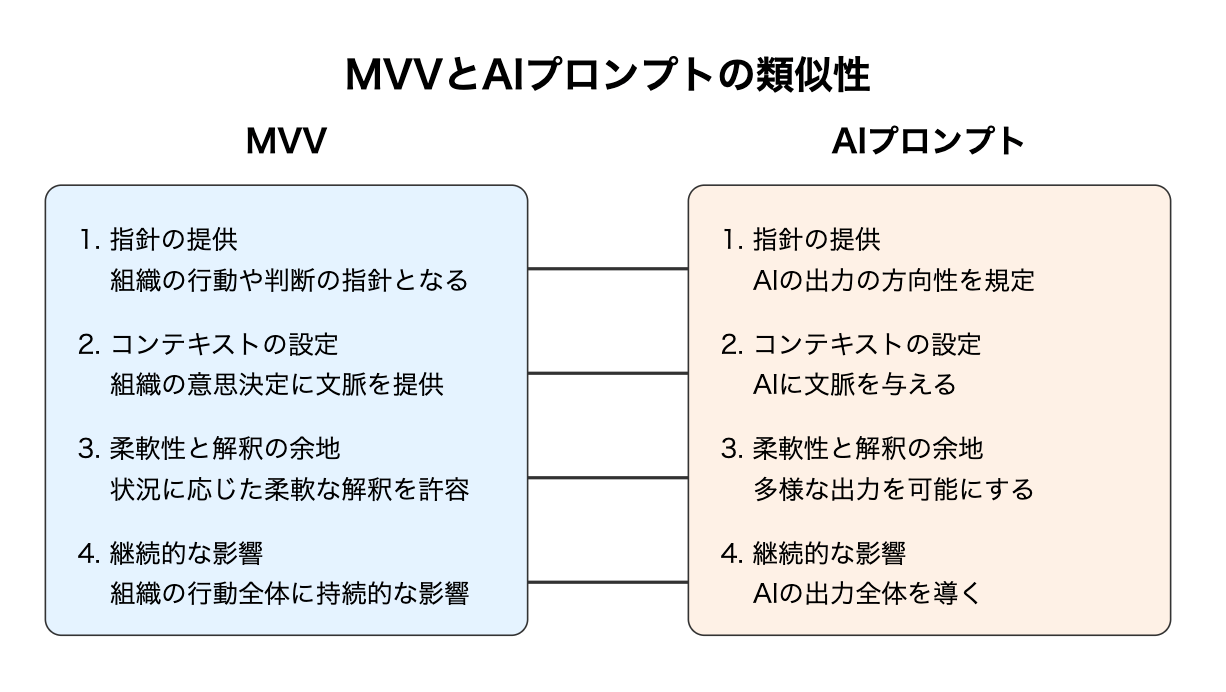
I have summarized it in the following diagram.
-
Providing Guidelines
- Just as a prompt for an AI defines the direction of the output, MVV serves as a guideline for the organization's actions and decisions.
-
Setting Context
- Just as a prompt provides context to an AI, MVV provides context for organizational decision-making.
-
Flexibility and Room for Interpretation
- Just as a high-quality prompt enables diverse outputs, MVV allows for flexible interpretation depending on the situation.
-
Continuous Influence
- Just as a prompt guides the overall output of an AI, MVV exerts a lasting influence on the overall behavior of the organization.

-
Improvement of Practicality
- Rather than an abstract ideal, it functions as a specific guideline that leads daily judgments and actions.
-
Flexible Application
- The interpretation of MVV can be flexibly adjusted according to the changing environment and circumstances.
-
Strengthening Employee Engagement
- By having room to interpret and apply MVV in their own way, proactive involvement is promoted.
-
Ensuring Consistency
- Consistency is created by the entire organization acting based on the same "prompt."
Now, let's look at how to apply this organizational prompt, MVV, by treating individuals as LLMs.
Recognizing and Practicing Organizational Prompts by Viewing Individuals as LLMs

1. Viewing Yourself as an "Organizational LLM"
-
Daily Reflection
- Record actions and decisions as "outputs"
- Analyze MVV elements that had an influence
2. Applying Prompt Engineering
-
Creating Personal MVV
- Reconstruct based on the organization's MVV in your own words
- Deeply reflect on the connection with your own role and values
3. Fine-tuning
-
Identifying MVV Strengthening Points by Role
- Identify MVV elements closely related to your job duties
- Create detailed behavioral guidelines
-
Integrating Personal Strengths and MVV
- Identify personal strengths
- Consider ways to contribute to the realization of MVV
-
Self-evaluation of MVV Practice Level
- Evaluate practice level regularly
- Formulate improvement plans based on evaluation results
In this way, using the LLM concept, we create opportunities to perceive MVV as something personal.
5. Summary
- By rethinking MVV (Mission, Vision, and Values) as a "prompt" for the organization, abstract concepts can be transformed into specific guidelines.
- By viewing individuals as LLMs (Large Language Models) and internalizing MVV as one's own prompt, both organizational consistency and individual diversity can be achieved.
- Through concrete steps such as daily reflection, creating a personal MVV, and identifying MVV strengthening points by role, MVV can be integrated into daily work.
6. Conclusion
By viewing MVV as a prompt,
the perception shifts from an abstract goal to a concrete prompt,
and I believe it becomes possible to drill down to specific measures using LLM concepts.
I hope this article helps you when thinking about MVV.
Discussion